What are the symptoms of measles and how can I best protect my child?

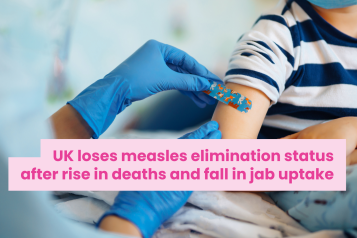
There has been a resurgence of measles in England and around the world in recent years. In 2024 there were 2,911 laboratory confirmed measles cases in England, the highest number of cases recorded annually in decades. Most of these cases have been in unvaccinated children under the age of 10.
What is measles?
Measles is an infection that spreads very easily and can cause serious problems in some people. Measles usually starts with cold-like symptoms, followed by a rash a few days later. Some people may also get small spots in their mouth.
Learn more about the symptoms on the NHS website.
Measles can lead to serious problems if it spreads to other parts of the body, such as the lungs or brain.
Problems that can be caused by measles include:
- pneumonia
- meningitis
- blindness
- seizures (fits)
These problems are rare, but some people are more at risk. This includes babies and people with weakened immune systems.
Measles in pregnancy
If you get measles when you're pregnant, it could harm your baby.
It can cause:
- miscarriage or stillbirth
- premature birth (before the 37th week of pregnancy)
- your baby having a low birthweight
It's important to get medical advice if you're pregnant and have been in close contact with someone who has measles.
Ask for an urgent GP appointment or get help from NHS 111 if:
- you think you or your child may have measles
- your child is under 1 year old and has come into contact with someone who has measles
- you've been in close contact with someone who has measles and you're pregnant or have a weakened immune system
- you or your child have not had measles or 2 doses of either the MMRV or MMR vaccine and you (or your child) have been in close contact with someone with measles
- you or your child have a high temperature that has not come down after taking paracetamol or ibuprofen
- you or your child have difficulty breathing – you may feel more short of breath than usual
- your baby or young child is not feeding well, or taking less feeds or fluids than usual
- you or your child are peeing less than usual (or your baby has fewer wet nappies)
- you or your child feels very unwell, or you're worried something is seriously wrong
Measles can spread to others easily. Call your GP surgery before you go in. They may suggest talking over the phone or arrange for you to come to a part of the surgery where you’re separated from others.
You can also call 111 or get help from 111 online.
What is the MMRV vaccination, and how is it different from the MMR?
Due to the introduction of a varicella (chickenpox) vaccination programme the measles, mumps, rubella and varicella (MMRV) vaccine replaced the MMR vaccine in the routine childhood programme from 1 January 2026. If your child was born on or after 1 January 2025, they will be offered their first dose of MMRV at 12 months old and their second dose of MMRV at 18 months old.
Vaccination is the most important thing we can do to protect ourselves and our children against ill health. They prevent millions of deaths worldwide every year.
Since vaccines were introduced in the UK, diseases like smallpox, polio and tetanus that used to kill or disable millions of people are either gone or are now very rarely seen.
Other diseases like measles and diphtheria have reduced to a very low number of cases each year since vaccines were introduced. These cases are often related to travel.
However, if people stop having vaccines, it's possible for infectious diseases to quickly spread again.
How well the MMRV vaccine works
Protection against measles, mumps and rubella starts within 2 weeks of having the MMRV vaccine. Protection against chickenpox starts within 3 weeks of having the vaccine.
After 2 doses:
- around 99% of children will be protected against measles and rubella
- around 97% of children will be protected against chickenpox
- around 88% of children will be protected against mumps
If your child gets mumps after being vaccinated, the symptoms will usually be much milder
For more information about the MMRV vaccine, visit the NHS website.